Monday, February 21, 2011

Creationism and Strawmen

I can’t tell you how much I cringe when I hear people say, “I just can’t imagine how we developed our complexity through random chance” and similar things, referring (incorrectly) to the “random” process of evolution. This is a strawman argument that is put forward: either total random chance or God. Creationists often do this, but it is also done on the other side.

Take, for example, a recent post I saw on Facebook from one of my friends:

...poses a direct challenge to all creationists. Provide an explanation for vestigial features of living organisms without inadvertently proving evolution.

He was surprised to learn that Answers in Genesis, the go-to place for all things creationist, had a position on vestigial features. That description made use of arguments from molecular biology, and so-called microevolution. It seems as if it is a common misunderstanding that creationists reject all of the apparatus of evolution and microbiology, and a simple, strawman statements like “creationists reject evolution” don’t hold.

It really does help to look at the best arguments from each side, to really see the limits of the analysis. Going back and forth between Talk Origins and Answers in Genesis is a good way to explore the arguments. For example, in transitional fossils we look in Answers in Genesis and find articles like this one and this one which steep of arguments from authority, claims without evidence, and cherry-picking. Many of the arguments rest on criticizing small details on a small number of fossils. In the talk origins article on transitional fossils, we get a very detailed, and seemingly complete, list of transitions from all major animal types. It comes in many parts, and details the characteristics on each transition.

Try it yourself! Pick a topic, go through and find the best arguments each has. It’s a very good exercise. Throw in a good dash of the baloney detection kit, and you’re on your way.

Friday, February 18, 2011

Wonders in Science

There is a tendency for scientists to be killjoys, raining on everyone parade, poo-pooing cherished beliefs and activities from acupuncture, religion, ufo’s, and homeopathy. Where is the wonder, the joy? I’ve had someone, after a particular session debunking UFO shows on the history channel, say “But wouldn’t it be great if they were true?” Yes! But I don’t want to give up intellectual honesty for wishful thinking. If it’s true, that’s great, but I won’t reduce my efforts to debunk it just because I’d love it to be true. In fact, wanting it to be true motivates me even more to be skeptical, knowing that I’ll be less critical of something I want to be true (as most humans are).

Here’s at least one piece of wonder in the Universe. See the Earth in this picture?

newrings_cassini-2011-02-18-10-17.jpg


This is a picture of Saturn, with the Sun behind it, taken from the Cassini spacecraft. See that little white speck in the rings, in the upper left? That’s the Earth! There are two responses I have when seeing this picture.

1) We’re really small and insignificant in this Universe
2) What an amazing thing that we can create something on the Earth, send it a billion miles, and be able to take a picture of ourselves. That’s amazing!

The universe is amazing, both in its magnitude and complexity, and we should feel a sense of awe. All this, without introducing unnecessary constructs such as deities. Although science is often accused of arrogance, I can think of no humbler activity than that which brought us the picture above.

Thursday, February 17, 2011

20 Years of Being an Atheist Ends Today

It was 20 years ago when I made the conscious decision to be an atheist. I had been agnostic before, and then made a decision that it was no longer a tenable position to hold, and that the atheist label was the one that matched my mindset best. Since I became an atheist 20 years ago, I never once regretted the decision. There hasn’t been anything at all that has moved me from that perspective, until this week.

I’ve seen the light, and I’ve realized that in some ways it was the wrong decision to become an atheist. I think it was what I needed at the time, and now it is not. I even changed my Facebook profile!

So, what changed my mind? Sam Harris did, in his lecture on the “Problem with Atheism”. Essentially, it boils down to the fact that we don’t need a word for not believing in something, and that to attach a charged word to it undermines the position. We don’t need, as he says, a name for “non-astrologer”. We just need to espouse the positive virtues of believing with sufficient evidence, for the quantification of uncertainty, of intellectual honesty and consistency.

So, in an effort to be more positive about my beliefs in evidence, rationality, and science, from now on I am not going to consider myself an atheist. If someone asks me if I believe in God, I will say I don’t believe in Zeus, Thor or Yahweh (or any of the other gods we’ve heaped on that pile we call mythology). If asked what religion I am, I’ll just say “None”.

Wednesday, February 16, 2011

The Role of Humanity into the Future

Yet again, IBM is creating AI to best humans in a task that has been, perhaps, a symbol of uniquely human activity: Jeopardy! The system, Watson, is doing quite well against the humans. The number of applications for this technology is nearly endless.

I’d wonder how this success will play into the broader discourse on the human intellect, and our view of ourselves on the universe. When Deep Blue defeated Kasparov, and the computer became (unofficially) the world chess champion, I remember having mixed feelings. We like our icons, I suppose, and hate to get rid of them. It’s like growing up, and losing Santa Claus, perhaps. The history of science has been to deflate human arrogance, and yet successes like Deep Blue and Watson are not quite the same because it is our own ingenuity which created them.

On some level, Watson feels like a different accomplishment than Deep Blue. Chess is deterministic, well formulated, and complex. It’s complexity is the only thing that challenges an easy computer solution, which was accomplished finally by brute force: get enough fast hardware attacking a well-described problem and you win....always. Watson isn’t nearly as well defined as chess, or at least it doesn’t appear to be as well defined.

Watching Watson, there is a creepy sort of feeling, probably due to too many evil AI movies (2001, Terminator, Matrix, etc...). Kids growing up today will have this sort of technology as the norm. All-in-all, an interesting series of events to keep watching!

Tuesday, February 15, 2011

Bill O'Reilly, Tides, and the God of the Gaps

The following link is a Bill O’Reilly interview with David Silverman, President of American Atheists:

http://www.youtube.com/watch?v=3XEgkViLbTk&t=1m40s

I love the look of shock on David’s face right after the “tides go in, tides go out, never a miscommunication. You can’t explain that.”. I think, however, David is completely ineffectual at conveying his point and looks like a jerk. As a followup, Bill responds to a letter in this video:

http://www.youtube.com/watch?v=UyHzhtARf8M

Here he concedes that the Moon causes the tides, but then adds a number of other questions:

  1. Where did the Moon come from?
  2. Where did the Sun come from?
  3. There is order in the universe. Where did we, in all of our intricacies come from?
  4. Why life on this planet and not on the other planets?
He states that, given this observed order in the universe, that it takes more faith to believe this was all luck, rather than in God.

Although many scientists would laugh at these questions, that is the wrong response. These are reasonable questions! They are ignorant and (because Bill should have done a bit of research before asking them), uninformed questions but they are reasonable first-questions one asks. If one is honest about getting answers (which I don’t think Bill is), there are ready answers to these direct questions but it seems to me that the intent of the questions is a bit different.

First he says we can’t explain the tides. So we explain the tides, with gravity and the Moon. Then he asks “where did the Moon come from?” He could have just as easily asked “where did gravity come from?”. It is clear from this line of questioning that there will never be a final answer to satisfy him. Each time we answer one, there will be concepts that that one builds on, etc...

This is classic God-of-the-Gaps, but it is something that I think needs to be dealt with in a more subtle way than David Silverman and many other atheists seem to do. I think most people, rightly, have a sense of wonder about the amazing order in the universe. I think most people immediately attach this order to a creator, the nearest cultural deity, because they don’t have any alternative: they are not informed. In order to dissuade them, I don’t think that insulting their deity is effective because they take that as insulting their sense of wonder, and then science seems like a sterile, arrogant, unimaginative bully.

We need to find a way to enhance their sense of wonder, and yet dismantle the notion that this requires some external deity. We need to keep the spirituality, as a secular notion espoused by Carl Sagan, Sam Harris and others, because that is what is really driving the issues for most people and we need to push the use of the deity farther and farther away from daily life. Science has to be seen as a creative endeavor, one which fully respects the wonder and awe we all see and feel as we ponder the universe.

Saturday, February 12, 2011

Why I Can't Support the Darwin Day Resolution

So I received a tweet asking for support for the Darwin Day Resolution.

The full text of the resolution is here:

Expressing support for designation of February 12, 2011, as Darwin Day and recognizing the importance of science in the betterment of humanity.
Whereas Charles Darwin’s theory of evolution by the mechanism of natural selection, together with the monumental amount of scientific evidence he compiled to support it, provides humanity with a logical and intellectually compelling explanation for the diversity of life on Earth;
Whereas the validity of Darwin’s theory of evolution by natural selection is further strongly supported by the modern understanding of the science of genetics;
Whereas it has been the human curiosity and ingenuity exemplified by Darwin that has promoted new scientific discoveries that have helped humanity solve many problems and improve living conditions;
Whereas the advancement of science must be protected from those unconcerned with the adverse impacts of global warming and climate change;
Whereas the teaching of creationism in some public schools compromises the scientific and academic integrity of the United States’ education systems;
Whereas Charles Darwin is a worthy symbol of scientific advancement on which to focus and around which to build a global celebration of science and humanity intended to promote a common bond among all of Earth’s peoples; and
Whereas, February 12, 2011, is the anniversary of the birth of Charles Darwin in 1809 and would be an appropriate date to designate as Darwin Day: Now, therefore, be it
Resolved, That the House of Representatives—
(1) supports the designation of Darwin Day; and
(2) recognizes Charles Darwin as a worthy symbol on which to celebrate the achievements of reason, science, and the advancement of human knowledge.

I was reading it with some interest, but then I get to the part about “the adverse impacts of global warming and climate change”. Why is climate change in there? There are so many obvious, uncontroversial topics directly related to evolution in medicine, pharmaceuticals, ecology, physiology, etc... that it seems to be both irrelevant and counterproductive to include it. Sure, the climate change folks think that denying it is like denying the holocaust or denying evolution, but it really isn’t nearly at that level. There are not the number of independent investigations and data supporting man-influenced climate change as there are for either evolution or the holocaust, even if the science were completely unambiguous on the topic (which it isn’t). To conflate the two is a serious tactical mistake, and a serious scientific mistake.

Although I support Darwin Day, I can’t support this resolution because of this ridiculous add-on.

Friday, February 11, 2011

The world is flat!

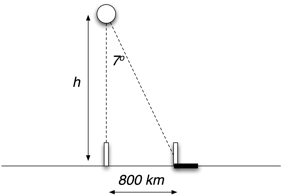
So, I was listening to a Cosmos episode when Carl Sagan described the method that Eratosthenes used to calculate the circumference of the Earth. He stated that, on a flat Earth, with the light from a far-away object like the Sun all shadows would be the same length. Seeing different-length shadows, as Eratosthenes did in his famous Summer Solstice observation, allows you to infer curvature. But the big assumption here is that the light is coming from very far away. If we had a flat Earth, it is easy to set up a situation where the Sun, directly overhead in some place, casts a 7 degree angle 800 km away as Eratosthenes observed.

Untitled-2011-02-11-11-52.png

This simple arrangement results in a distance to the Sun of about 6500 km. The world is flat!

So, we have two different explanations of the observations. How do we distinguish between them? Answer: the way it is always done in science - spin out the consequences of each, and make predictions where they disagree.

It is easy to show that continuing this calculation would result in some striking predictions. First, given this distance, and the fact that shadows change over the day, the apparent size of the Sun would be very different from one location and another...and it is never observed to be different, even across years. This suggests a very distant Sun. Further, you’d have to make sure that the Moon was closer than the Sun (inferred from eclipses) in both models. Once you do this, then you have two objects with the apparent size problem in the flat-Earth model, again not supported by observation. There are probably many other predictions this model makes which could easily have been verified by the ancients, so it is no surprise that they did not consider it in their calculations.

It is useful, however, to think about the consequences of models beyond the data they agree with.