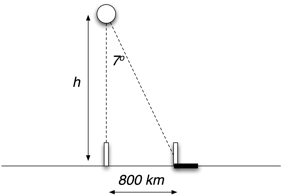
This simple arrangement results in a distance to the Sun of about 6500 km. The world is flat!
So, we have two different explanations of the observations. How do we distinguish between them? Answer: the way it is always done in science - spin out the consequences of each, and make predictions where they disagree.
It is easy to show that continuing this calculation would result in some striking predictions. First, given this distance, and the fact that shadows change over the day, the apparent size of the Sun would be very different from one location and another...and it is never observed to be different, even across years. This suggests a very distant Sun. Further, you’d have to make sure that the Moon was closer than the Sun (inferred from eclipses) in both models. Once you do this, then you have two objects with the apparent size problem in the flat-Earth model, again not supported by observation. There are probably many other predictions this model makes which could easily have been verified by the ancients, so it is no surprise that they did not consider it in their calculations.
It is useful, however, to think about the consequences of models beyond the data they agree with.


In other words, Sagan was being deceitful when he brainwashed the viewers of his PROGRAM into believing different lengths of shadow show a spherical earth.
ReplyDeleteYour reasoning is circular and rhetorical, designed to reach pre-established conclusions.
The alleged astronomical distance between earth and sun was REQUIRED and POSITED to make heliocentrism work, as is the absurd alleged distance of the stars, required to justify the absurd absence of observable parallax.
I know what you are going to say: 'but we DID observe parallax'.
Right, if you first take the theoretical baseline of the earth-sun distance and then INFER the parallax.
It took them 150 years or so to come up with some type of HIGHLY unconvincing parallax, and we certainly can't observe it from earth.
As always, we are simply gonna have to BELIEVE.
Well, I don't conceive of REAL SCIENCE as something of a religious nature.
Isn't it a fact that the only reason you actually believe the sun is 150,000,000,000 meters away from us is that it is TOO INCONVENIENT to even entertain the notion that you could have been LIED TO?
Let's face it, the distance is absurd, and NASA isn't exactly a transparent bastion of science.
Do your homework, observe the countless youtube vids' footage of foul ups of the ISS propaganda, showing WATER BUBBLES.
Observe the ridiculous, VERY TENSE post Apollo press conference after the ludicrous moonlanding footage.
You have been had but problem is, if you face this fact, you'll be having trouble paying your mortgage, won't you?
You have INVESTMENTS in the consensual model being true, even though it should be easy to REAL scientists to see what a sham it all is...
reply posted over at my current location: http://web.bryant.edu/~bblais/the-world-is-flat.html
Delete