Tuesday, January 12, 2010
A couple of interesting videos
With the advent of computer technology, it can be challenging to distinguish fact from fiction. Both of the videos below are, in my opinion, strikingly real but are both fake (and funny!). Critical thinking skills are a must!


Creativity, Science, and the Brain
In my post about Bruce Hood's interview I said there wasn't anything I disagreed with. After re-listening to it, I find my position is a bit more nuanced. I'd still like to look more closely at the experiments he cites to see if there is anything there that addresses my concerns, like the difference between believing in an external essence of an object versus experiencing the memories that an object elicits. In this post I want to address something that both Bruce and Tom dance around during the interview: the positive aspects of superstition.
Tom tries to tie Bruce down concerning the bad aspects of superstition, citing witch burning and crusades. Bruce refuses to acknowledge superstition as a bad thing, and simply states that superstitious thinking, combined with economic factors and political motivation, can lead to such bad consequences. He further states that intuitive thinking is essential for science. Science doesn't just creep forward in small steps, but is also driven by the intuitive leaps of the scientists. Our ability to see patterns leads us to the patterns we have accumulated in scientific knowledge, and this ability is a consequence of natural selection.
Bruce Hood further talks about unconscious reasoning, such as the dream of Friedrich Kekulé and the structure of benzene, and solving problems while you sleep or are taking a break. I myself have solved some problems this way, and many of the interesting physics problems that I have used in my teaching have come, seemingly randomly, while doing mundane things like raking leaves or taking a shower. Although he states that he is an atheist, and is a scientist, I don't think he goes far enough in supporting science. In this way, his omission leads to the sense that he is a bit too supportive of the poor thinking associated with superstition. He points out that much of it is not factually correct, but I think he misses a big point in his exposition (one that I am quite confident he'd agree with).
Carl Sagan put it this way:
Thus, Bruce's "super-sense" is the starting point, the intuition which leads to "crazy" ideas, out-of-the-box solutions. Skepticism, open information, and honesty reduce the many possible ideas down to the ones that are true. In some way, this is like the process of natural selection: the "random" element in evolution (mutation, crossover, etc...) leads to variation, and natural selection works on that variation to produce the (far fewer) solutions that are optimal for the various ecological niches. In science, intuition gives us the variation, and skepticism and careful observation work on that variation to produce the (far fewer) solutions that are true.
Finally, in the fine words of Carl Sagan from his book "A Demon Haunted World" (the best science book for the public I have ever read!):
Tom tries to tie Bruce down concerning the bad aspects of superstition, citing witch burning and crusades. Bruce refuses to acknowledge superstition as a bad thing, and simply states that superstitious thinking, combined with economic factors and political motivation, can lead to such bad consequences. He further states that intuitive thinking is essential for science. Science doesn't just creep forward in small steps, but is also driven by the intuitive leaps of the scientists. Our ability to see patterns leads us to the patterns we have accumulated in scientific knowledge, and this ability is a consequence of natural selection.
Bruce Hood further talks about unconscious reasoning, such as the dream of Friedrich Kekulé and the structure of benzene, and solving problems while you sleep or are taking a break. I myself have solved some problems this way, and many of the interesting physics problems that I have used in my teaching have come, seemingly randomly, while doing mundane things like raking leaves or taking a shower. Although he states that he is an atheist, and is a scientist, I don't think he goes far enough in supporting science. In this way, his omission leads to the sense that he is a bit too supportive of the poor thinking associated with superstition. He points out that much of it is not factually correct, but I think he misses a big point in his exposition (one that I am quite confident he'd agree with).
Carl Sagan put it this way:
At the heart of science is an essential balance between two seemingly contradictory attitudes—an openness to new ideas, no matter how bizarre or counterintuitive they may be, and the most ruthless skeptical scrutiny of all ideas, old and new. This is how deep truths are winnowed from deep nonsense.It is this sentiment that is missing from the interview, and would have cleared up many of the questions. Yes, we are all programmed (via natural selection) to be superstitious, to see patterns that may or may not really exist, to attribute properties to objects that may or may not be real. Science works by starting with that, and skeptically testing every pattern to see if it is real. It is only the ones that can stand up to skeptical scrutiny that we can trust.
Thus, Bruce's "super-sense" is the starting point, the intuition which leads to "crazy" ideas, out-of-the-box solutions. Skepticism, open information, and honesty reduce the many possible ideas down to the ones that are true. In some way, this is like the process of natural selection: the "random" element in evolution (mutation, crossover, etc...) leads to variation, and natural selection works on that variation to produce the (far fewer) solutions that are optimal for the various ecological niches. In science, intuition gives us the variation, and skepticism and careful observation work on that variation to produce the (far fewer) solutions that are true.
Finally, in the fine words of Carl Sagan from his book "A Demon Haunted World" (the best science book for the public I have ever read!):
A physicist has an idea. The more he thinks it through, the more sense it seems to make. He consults the scientific literature. The more he reads, the more promising the idea becomes. Thus prepared, he goes to the laboratory and devises an experiment to test it. The experiment is painstaking. Many possibilities are checked. The accuracy of the measurement is refined, the error bars reduced. He lets the chips fall where they may. He is devoted only to what the experiment teaches. At the end of all this work, through careful experimentation, the idea is found to be worthless. So the physicist discards it, frees his mind from the clutter of error, and moves on to something else.
Thursday, January 7, 2010
Believing the unbelieveable
Have a listen to this excellent interview of neuroscientist Bruce Hood. I can't think of a single thing I disagreed with this guy on. I may have more specific to say later, and perhaps I will buy his book.
A teachable moment...lost
So I just watched the Mythbusters episode where they recreate the bus jump from the movie Speed. They do two things: a miniature version and full-scale recreation. In their miniature version they scale down the bus by a factor of 12, very carefully building the model bus as closely as possible. Then they scale down the bridge by the same factor. They then point out that they can't scale down gravity without going to the moon. Technically, that would scale gravity by 1/6, not the required 1/12. You wouldn't even have to go nearly as far as the Moon to achieve this. Since force gravity decreases as the square of the distance away from the Earth (starting at 4000mi, the radius of the Earth), you would only have to go up this high:
Their analysis is equivalent to the following: the components of the speed off of a ramped angle are
I certainly wouldn't expect the television audience to follow that analysis, although I wouldn't mind them showing it anyway (but more explicitly). It's the sort of thing where many would ignore it, but the ones who could understand it would get more out of the show. So let's see if we can put it a bit more clearly. I'd start, first, by scaling down the sizes by a factor of 16 not 12. That way I can take the square root more easily. Then there'd be two more facts about gravity that I would mention
Scaling down just the size, but not the speed, by a factor of 16 would decrease the time by the same factor of 16. If we scale the speed down by a factor of 4, then three things happen: the height of the trajectory reduces by 16 (item 2 above), the time of flight reduces by a factor of 4, and thus the horizontal distance covered (speed times time) is reduced by a factor of 4x4=16. Notice that in doing so, the object trajectory is scaled in both the vertical and horizontal directions by 16, which is the goal of the scaling.
I think that this is clearer than the way presented by Mythbusters, and should have been covered in this way, or some similar way. It could have have been a good teaching moment!

compared to the 240,000 mi, that's a real bargain! But this is about 10,000 mi above the Earth, whereas the Hubble is less than 600 mi above the Earth, just to give some perspective.
So, without leaving the Earth, the NASA experts say that one can compensate by going faster. Mythbusters scrawls the analysis on the side of the buss and says "basically, what these hieroglyphics mean is to compensate for the physical impossibility of scaling gravity, the speed of our 1/12 scale bus has to be just over 20 miles per hour". What bothers me most about this is not that they don't really go through the analysis, but that they refer to basic math as hieroglyphics and they give no sense for why going a bit faster would compensate for gravity. I am going to include the full analysis here, but below I will also give a simpler explanation that they could have used, which only includes a small amount of math that would have easily fit on the side of the bus.
Analysis
Their analysis is equivalent to the following: the components of the speed off of a ramped angle are

and the x and y positions versus time are given by the standard motion equations

Here is the critical step. We solve for time, t, and get rid of it in the second equation. This way we have the shape of the entire trajectory in space, without any dependance on time.

or:

Now, what happens to this equation when we scale the distances down by a certain amount?
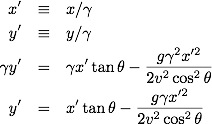
which is almost the same, except for one factor of gamma over the v2 term. Thus, if we replace the speed with

the trajectory of the new version is identical to the old version. Now, remember, that this doesn't include time: the scaled version, going a faster, will reach the destination sooner.
A Clearer Way
I certainly wouldn't expect the television audience to follow that analysis, although I wouldn't mind them showing it anyway (but more explicitly). It's the sort of thing where many would ignore it, but the ones who could understand it would get more out of the show. So let's see if we can put it a bit more clearly. I'd start, first, by scaling down the sizes by a factor of 16 not 12. That way I can take the square root more easily. Then there'd be two more facts about gravity that I would mention
- gravity doesn't affect motion horizontally
- vertically, if I throw something up at three times the speed, it will go up nine times the height (the square of the speed increase)
Scaling down just the size, but not the speed, by a factor of 16 would decrease the time by the same factor of 16. If we scale the speed down by a factor of 4, then three things happen: the height of the trajectory reduces by 16 (item 2 above), the time of flight reduces by a factor of 4, and thus the horizontal distance covered (speed times time) is reduced by a factor of 4x4=16. Notice that in doing so, the object trajectory is scaled in both the vertical and horizontal directions by 16, which is the goal of the scaling.
I think that this is clearer than the way presented by Mythbusters, and should have been covered in this way, or some similar way. It could have have been a good teaching moment!
Tuesday, January 5, 2010
There once was a girl named Florida (a.k.a Evil problems in probability)
In a previous post I described the Monty Hall problem, and noted that a simulation can often lead to clarity of thinking on tough probability problems. I take another example here, in two steps, and throw analysis and simulation at it and possibly a bit of intuition.
I was first introduced to this problem from Leonard Mlodinow's "The Drunkard's Walk: How Randomness Rules Our Lives" and immediately "fell for the trap". The problem exists in two parts, the first (easy) part followed by the second (hard) part. The easy part is as follows:
An easy way to do this is to list out the possibilities:
I was first introduced to this problem from Leonard Mlodinow's "The Drunkard's Walk: How Randomness Rules Our Lives" and immediately "fell for the trap". The problem exists in two parts, the first (easy) part followed by the second (hard) part. The easy part is as follows:
Say you know a family has two children, and further that at least one of them is a girl. What is the probability that they have two girls?
An easy way to do this is to list out the possibilities:
- Boy-Girl
- Girl-Boy
- Girl-Girl
Say you know a family has two children, and further that at least one of them is a girl named Florida. What is the probability that they have two girls?At first I didn't think it would make any difference. How could knowing the name of the child change the chances for two girls? So I didn't believe the author (at first) that the chances were even, p=0.5, for the family to have two girls. Again we can list off the possibilities:
- Boy-Girl (Florida)
- Girl (Florida)-Boy
- Girl (Not Florida)-Girl (Florida)
- Girl (Florida)-Girl (Not Florida)
- Girl (Florida)-Girl (Florida)
- write a simulation which reproduces it
- show that a formal analysis works for the problem
Probability for a girl to be named Florida:  0.01
Total number of families with two children:  1000000
999862 girls (0.499931 of children)
249745 both girls (0.249745)
750117 families with girls (0.750117)
249745 both girls (0.332941) given families with girls
10084 families with a girls named florida
4997 both girls (0.495537) given families with girl named florida
The formal analysis gets interesting, because I want to understand how the frequency, f, of the name affects the probability of having two girls. If it is a rare name (f ~ 0) then I should get p=0.5. For a common name (f ~ 1) then I should get p=1/3. Not that with f=1 then the word "name" is a little odd because all girls have it, so one might think of it as a label (like "has a nose"). First some notation:

Applying Bayes theorem to the easy problem, we get:
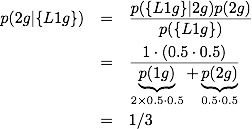
The hard problem is set up like:

It is clear that p({L1g}|2g)=1 whereas p({L1g},F|2g)=1 is not: given that we have 2 girls, we definitely have at least one girl, but we need not have at least one girl named Florida. Breaking the second term up we get

Now we have
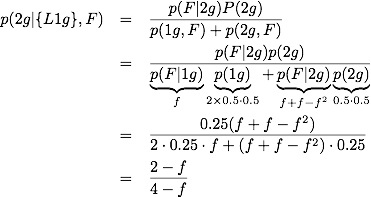
It is easy to check that it has the right limits:

I'm not sure if there is a better way to address this problem, but the analysis and simulation agree, and further we have a very simple form for how the probability depends on the frequency of the known label (e.g. Florida).
Code for simulation
from pylab import *
from numpy import *

# 2 daughter problem

num_families=1000000
num_children_per_family=2

f_girls=0.5
f_florida=0.01
print "Probability for a girl to be named Florida: ",f_florida
print "Total number of families with two children: ",num_families

child_types=['boy','girl']
families=[ (child_types[randint(2)],child_types[randint(2)]) for x in range(num_families)]

names=[]
for f in families:

    if f[0]=='boy':
        name1='Bob'
    else:
        name1='Florida' if rand() < f_florida else 'Sarah'

    if f[1]=='boy':
        name2='Bob'
    else:
        name2='Florida' if rand()< f_florida and name1!='Florida' else 'Sarah'

    names.append( (name1,name2) )

# total fraction of children as girls
girls=0
children=0
for f in families:
    for c in f:
        children+=1
        if c=='girl':
            girls+=1
print "%d girls (%f of children)" % (girls,float(girls)/children)

# total fraction of families with both girls
both_girls=0
for f in families:
    if f[0]=='girl' and f[1]=='girl':
        both_girls+=1
print "%d both girls (%f)" % (both_girls,float(both_girls)/num_families)

# total fraction of families with both girls GIVEN that the family has a girl
families_with_girls=[]
for f in families:
    if f[0]=='girl' or f[1]=='girl':
        families_with_girls.append(f)

num_families_with_girls=len(families_with_girls)
print "%d families with girls (%f)" % (num_families_with_girls,
                        float(num_families_with_girls)/num_families)

both_girls=0
for f in families_with_girls:
    if f[0]=='girl' and f[1]=='girl':
        both_girls+=1
print "%d both girls (%f) given families with girls" % (both_girls,
                            float(both_girls)/num_families_with_girls)


# total fraction of families with both girls GIVEN that the family has a girl named florida
families_with_florida=[]
for n,f in zip(names,families):
    if f[0]=='girl' and n[0]=='Florida' or f[1]=='girl' and n[1]=='Florida':
        families_with_florida.append(f)

num_families_with_florida=len(families_with_florida)
print "%d families with a girls named florida" % num_families_with_florida

both_girls=0
for f in families_with_florida:
    if f[0]=='girl' and f[1]=='girl':
        both_girls+=1
print "%d both girls (%f) given families with girl named florida" % (both_girls,
                            float(both_girls)/num_families_with_florida)
Weird associations and the brain
You ever have deja vu? The brain associates many things together, and can often give you the visceral feeling that you've been there before. For several years I have had a very specific deja vu that I have finally tracked down. I found for some reason that when I watched the movie Unbreakable (great movie!) that later in the day I would recall a video game in my distant past called the Legend of Zelda, that I played on our Nintendo game machine. This happened a couple of times, so I felt there was some association that I couldn't quite pick up.
Then I noticed that each time, I was humming the theme song to Zelda during the day, and I finally figured out the association: the musical transitions in the themes are close enough that hearing one, I would continue with the other. The clips are below. If you listen to about 30 seconds of the Unbreakable music, you'll get the theme, and then go back to the Zelda clip. How random! But now I have the satisfaction of a puzzle solved!
Then I noticed that each time, I was humming the theme song to Zelda during the day, and I finally figured out the association: the musical transitions in the themes are close enough that hearing one, I would continue with the other. The clips are below. If you listen to about 30 seconds of the Unbreakable music, you'll get the theme, and then go back to the Zelda clip. How random! But now I have the satisfaction of a puzzle solved!
Monday, January 4, 2010
Cool little fact of the day...
Did you know that if you interleave the pages of two phone books, that it is nearly impossible to separate?
For those Mythbusters aficionados this won't be news, but since I don't watch TV I missed this one. I just heard about it yesterday, and didn't believe it. So I did a quick test myself and confirmed it! Very cool!
You can see what mythbusters does with it here (note: it involves tanks):
http://www.youtube.com/watch?v=hOt-D_ee-JE
For those Mythbusters aficionados this won't be news, but since I don't watch TV I missed this one. I just heard about it yesterday, and didn't believe it. So I did a quick test myself and confirmed it! Very cool!
You can see what mythbusters does with it here (note: it involves tanks):
http://www.youtube.com/watch?v=hOt-D_ee-JE
Subscribe to:
Posts (Atom)